
August 14, 2026
Capped composite fencing has a bonded polymer shell around its wood-plastic core, while uncapped composite fencing leaves that core exposed at the surface. The cap usually improves resistance to sunlight, moisture, stains, and light abrasion, and it raises the purchase price.
Table of Contents
Composite fence boards blend wood fiber, recycled plastic, pigments, stabilizers, and binding additives, shaped under heat into boards or interlocking profiles. This blend is called wood-plastic composite, or WPC. The core difference is one protective layer: capped boards carry a polymer shell, while uncapped boards expose the wood-plastic composite core.
The cap separates the WPC core from direct outdoor exposure, and manufacturers usually bond it during coextrusion. The shell can hold pigments, UV stabilizers, and antioxidants. Coverage varies, since some boards protect selected faces while others wrap the full profile.
Capped fencing gives stronger surface protection, while uncapped fencing gives a lower initial cost.
| Feature | Capped composite fencing | Uncapped composite fencing |
| Surface | WPC core with bonded shell | Exposed WPC core |
| UV resistance | Usually higher | More dependent on pigments |
| Moisture protection | Higher on capped faces | More dependent on core quality |
| Stain resistance | Easier to clean | Stains may penetrate sooner |
| Scratch resistance | Usually better | Wear may show sooner |
| Routine care | Wash with mild cleaner | Similar care, often more often |
| Initial price | Higher | Lower |
| Best fit | Exposed, long term projects | Mild, sheltered projects |
Product design, installation, climate, and care all shift these outcomes, so treat the table as general guidance.
Capped composite fencing usually resists fading, moisture, stains, and light surface wear better than uncapped fencing.
Capped composite fencing usually holds color longer because its shell carries UV stabilizers, while uncapped boards can lighten after long exposure. The rate depends on pigments, stabilizers, orientation, and local sun. Compare samples outdoors, since direct sun quickly reveals undertones, and read the fade warranty for its defined color change limit. Our composite fence color guide helps you match undertones before you commit.
Capped composite fencing usually performs better in wet conditions because the shell limits direct surface exposure. If you have ever seen a fence base swell and darken after a wet winter, that is moisture meeting an exposed core. The shell does not make every joint or cut edge waterproof, so ground clearance and drainage still matter. Boards should not contact soil unless the system allows it.
Capped composite fencing can still pick up scratches, dents, heat marks, and impact damage. The shell helps with light abrasion, but deep scratches can expose a differently colored core. Sanding is usually unsuitable, since it removes the finish, so use the cleaning and repair methods the manufacturer lists.
Capped composite fencing usually carries lower surface maintenance risk, since dirt and spills stay closer to the shell. Most composite systems need no routine paint or stain, and general cleaning uses mild soap, water, and a soft brush. Uncapped boards may need washing more often, and early replacement can erase the initial savings.

The right composite fencing matches site exposure, structural needs, budget, and the maintenance level you accept.
Capped composite fencing is the safer choice for strong sun, salt air, heavy rain, and high humidity, and pool areas favor it because splashes and cleaning residues reach the fence. Use corrosion-resistant posts and fasteners where salt is present, since the board cannot protect unsuitable metal.
Uncapped composite fencing can offer better value in mild, shaded, relatively dry spots, such as an internal divider or a low-visibility boundary. Shade does not remove wind or thermal movement, so verify board strength, post spacing, and expansion gaps. Sound composite fence installation matters as much as the cap, because composite expands with temperature and needs the gap listed in its manual.
Verify cap coverage, dimensions, test data, installation rules, and warranty terms before ordering.
| Specification | What to verify |
| Cap coverage | Selected faces or full profile |
| Board profile | Solid, hollow, or reinforced |
| Board dimensions | Actual thickness, width, and length |
| UV information | Test method or written fade coverage |
| Moisture guidance | Ground clearance and wet area limits |
| Structural limits | Height, post spacing, and wind guidance |
| Cut end treatment | Trim, cap, sealant, or none |
| Warranty | Covered defects, duration, and exclusions |

Capped composite fencing gives better surface protection in sunny, wet, coastal, and high-use locations, while uncapped fencing can cut cost in mild, sheltered projects. Neither performs well with weak posts, wrong spacing, or poor drainage, so compare cap coverage, board profile, installation rules, and written warranty terms, not just the panel price.
To see COOWIN capped construction up close, request a free sample, compare the composite fencing options, or contact COOWIN’s team for project-specific advice.
Capped composite fencing is a WPC board wrapped in a bonded polymer shell, usually added during coextrusion. The shell protects the core from UV, moisture, stains, and light abrasion. Coverage may protect selected faces or the full profile, so inspect the edge to confirm.
Uncapped composite fencing can fade because its pigmented surface stays directly exposed to sunlight. The rate depends on pigment quality, UV stabilizers, orientation, and climate, and some early color shift can occur in the first weeks after installation. Compare outdoor samples and read the written fade terms before you pick a color.
Most composite fencing needs no routine sealing, painting, or staining, unlike wood. General cleaning uses water, mild soap, and a soft brush. Uncapped boards may need more frequent washing, since the exposed surface can hold stains. Follow the product manual before using bleach, solvents, abrasive pads, or a pressure washer.
Capped composite fencing is usually worth the added cost in strong sun, frequent rain, salt air, or high-visibility installs. The shell improves surface protection and can lower cleaning effort. Uncapped fencing offers better value in mild, shaded spots. Compare the full installed cost, warranty, and expected maintenance, not only the board price.
Cut ends on capped composite fencing expose the WPC core, since the shell only wraps the factory faces. Many systems ask you to seal, trim, or cap exposed ends, while others leave them untreated. Check the installation manual before cutting, and keep cut ends off wet soil to limit moisture uptake.

Can You Put Composite Decking Over Existing Wood Deck?
How Much Does a 20 x 20 Composite Decking Cost in 2026?
What Is The Best Decking Material For Full Sun?
Why Does Composite Decking Warp and How to Fix It?
Can You Just Replace Deck Boards with Composite?
How to Building a Pool Deck Around an Above Ground Pool
 Composite vs. Vinyl Fences: Pros, Cons, and Costs
 Will Composite Decking Become Slippery in Winter?
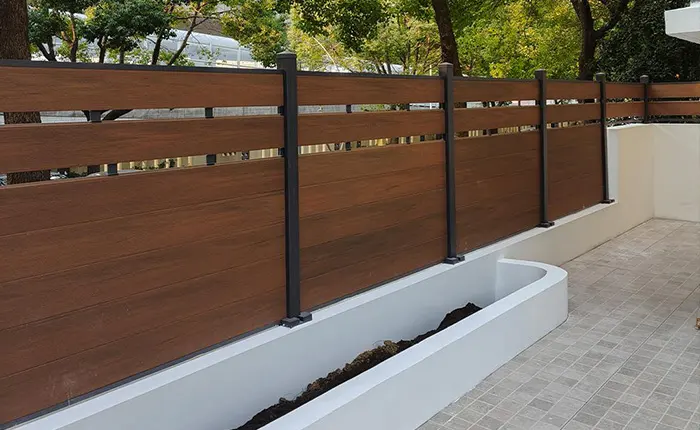 Composite Fencing for Windy Areas: Wind Load and Design Tips
 How To Finish Off Composite Decking Edges?
